Demand Surge and Post Loss Construction Costs: Why rebuilding after major events costs more and takes longer than expected

Rebuilding a home is rarely as simple as putting materials and labor back in place.
When a loss occurs in isolation, rebuilding costs often resemble the estimates that were used when the Policy was written. But when many homes are damaged at once, the economics of rebuilding change quickly. This phenomenon, known as demand surge, is one of the most powerful and least understood drivers of underinsurance.
Demand surge does not reflect poor planning or price gouging. It reflects basic supply and demand colliding with urgent need. For the purposes of this article, we are going to summarize demand surge as it relates to underinsurance, but for a much deeper dive including case studies and solutions for disaster survivors, check our entire book about Demand Surge inside the Recovery Series.
What demand surge actually means
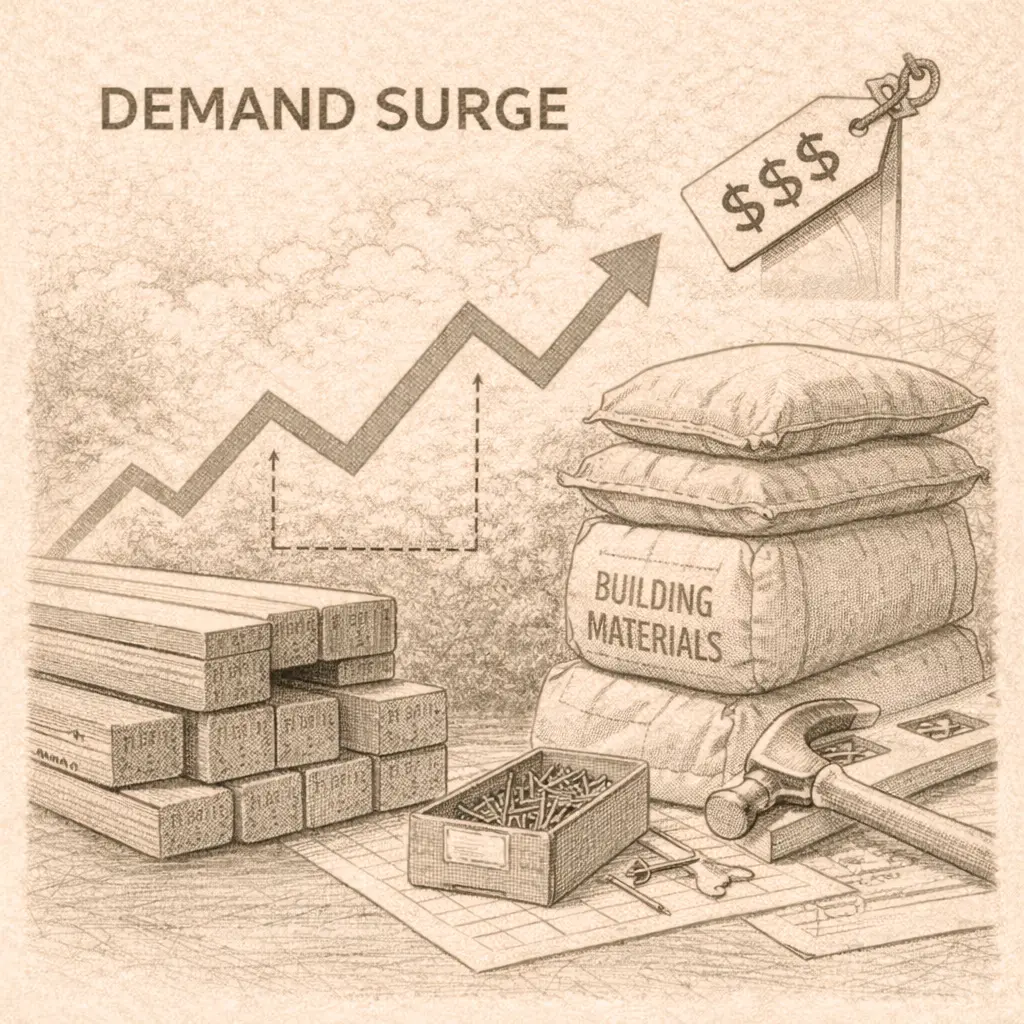
Demand surge occurs when a large number of properties require repairs or rebuilding at the same time, overwhelming the available supply of contractors, materials, and permitting capacity.
Labor becomes scarce. Specialized trades are booked months in advance. Materials that were readily available become harder to source. Prices rise not because work becomes more elaborate, but because the competition for limited resources intensifies.
These conditions can emerge after wildfires, hurricanes, floods, earthquakes, or even regional storms that affect a wide area. The larger the event, the longer the surge tends to last.

Why surge affects timing as much as cost
Demand surge is not only about higher prices. It also affects how long rebuilding takes.
Contractors prioritize projects differently. Permitting offices face backlogs. Inspections take longer to schedule. Even decisions that would normally be resolved quickly can stall when systems are strained.
As timelines stretch, costs rise further. Extended labor commitments, temporary measures, and repeated mobilization all add expense. At the same time, homeowners remain displaced, increasing the strain on living expense coverage.
This combination of rising rebuild costs and longer timelines is a common reason coverage that seemed adequate becomes insufficient.
How surge exposes hidden assumptions in policies
Most dwelling limits and rebuild estimates are created under normal market conditions. They assume steady labor availability, predictable pricing, and reasonable timelines.
Demand surge breaks those assumptions.
Even policies with solid base limits can struggle when rebuild costs rise rapidly. Extended replacement coverage may help absorb moderate increases, but severe or prolonged surge can push costs beyond those buffers.
Because demand surge is episodic, it is easy to underestimate its impact during calm periods. Yet it is precisely during these events that insurance is tested most heavily.
Example
After a major wildfire affects an entire region, contractors become scarce and material prices spike. A homeowner’s rebuild estimate was accurate before the event, but bids now come in significantly higher. The dwelling limit plus extended replacement coverage covers most of the cost, but not all of it. The remaining gap is driven not by poor estimation, but by surge conditions.
Why surge varies by location and event
Demand surge does not affect every area equally.
Regions with limited construction labor, geographic constraints, or complex permitting processes often experience more intense and longer lasting surge effects. Remote areas, high cost markets, and places prone to repeated disasters are particularly vulnerable.
The type of event also matters. Wildfires that destroy entire neighborhoods create different rebuilding pressures than localized storms or isolated losses. Understanding regional patterns helps explain why coverage that works well in one area may struggle in another.
The compounding effect on displacement costs
As rebuilding timelines extend, living expense coverage comes under pressure.
Temporary housing becomes harder to find as demand increases. Rental prices rise. Short term solutions turn into long term arrangements. Even homeowners with generous living expense limits may find that coverage runs out before rebuilding is complete.
This compounding effect is one of the reasons underinsurance often spans multiple coverage buckets during major events.
Planning for uncertainty, not perfection
Demand surge is difficult to predict precisely. Its severity depends on the scale of the event, the resilience of local infrastructure, and broader economic conditions.
Rather than trying to anticipate every scenario, it is more useful to recognize that surge is a normal part of large scale recovery and to plan for uncertainty. Coverage structures that include flexibility, such as extended replacement and sufficient living expense limits, are better positioned to absorb these shocks.
Understanding demand surge shifts expectations away from ideal conditions and toward how rebuilding actually unfolds after widespread loss.
Wrap-Up
Demand surge explains why rebuilding after major events is often far more expensive and slower than homeowners expect.
It exposes the limits of estimates created under normal conditions and places pressure on both dwelling and living expense coverage. Recognizing how surge works helps explain why underinsurance often appears during large scale disasters, even for homeowners who believed their coverage was strong.
In the next article, we will look at building codes and ordinance or law coverage, and why rebuilding often costs more simply because standards have changed since a home was first built.